The Centre for Fortean Zoology was founded in the UK in 1992 - nearly 20 years ago. Over the past two decades it has expanded to become a truly global organisation. We opened our American office in 2001, our Australian office in 2009, and now - in our 19th year - we are proud to welcome CFZ Canada to the CFZ global family.

Sunday, 29 April 2012

Bigfoot From the Bottom Up Part 6: Big Hairy Deal


Reports of the humanoid/hominid we call Sasquatch here in Canada come in from all over the world.  In the US most think of him as Bigfoot, whereas in the Far East he is known as a Yeti.  In fact, there are dozens of names associated with this big hairy best.  Here is a list:

The Wood Man
Boqs
Snanaik
Bushmen
Timber Giants
Big Figure
Bukwas/Bukwus
Wild Man of the Woods
Dzonoqua/Tsonoqua
Wild Woman of the Woods
evil seeker
Sne nah, or Owl Women
Tsadjatko, or giants
Skukum
Hecaitomixw, or Devil of the Forest
Oeh
Tsaaloh, or, Giants
Stick Indians
Sasquatch
Windigo
The Hairy Man
Ice Giant
Man-mountain
Chenoo
Gilyuk
Tuneq
Massikruman
Chuchunaa
Nakani
Mount St. Helens gorillas
Goat man


Nant’ina
Get’qun
Na’in, or Brushman
Koosh Taa Kaa, or Otterman
Nantiinaq
Urayuli
Miitiipi
Madukarahat, or Giant
Loo poo oi’yes
Yahyahaas
Yeti
Olayome
Oh-Mah
Stoneclad
Nun Yunu Wi
The Stone Man
Kecleh-Kudleh
Atahsaia
stetats
Nalusa Falaya
Shampe
Skunk ape
Char-Man
Swamp ape
Nyalmo
Orang Dalam
Bosjesman
Oo-el-en
Zoobie
Nuk-Luk
Devil Monkey
Honey Island Swamp Monster
Fouke Monster

Ot ne yar heh
Stonish Giants
Ge no sqwa
The Stone Giants
Ge no’sgwa
The Stone Coats
Esti Capcaki
Albatwitches
Chiye tanka
Rugaru
The Big Man
Woods Devils
See’atco
Skookum
Yi’ dyi’ tay
Tsiatko
Seatco
Tso’apittse
Cannibal
Ste ye hah
Splintercat
Yeahoh
So’yoko
T’oylona
Tornit
Momo
Lizard man
Flint Monster
Kung-Lu
Stick Indian
No Heads
No necks
Catamounts
Ft. Worth Monster
Boggy Creek Monster


To be fair, some of these names are not necessarily associated with Bigfoot creatures exactly.  There is some discussion among researchers that beings like Lizard Man and Windigo are not at all like him, but rather creatures of their own kind, or even hoax and fictional creatures.

Like the many different names, the big hairy man has been described with many hair colors and varieties.  North America Bigfoot Search has developed a “trait sheet” wherein they identify hair color in bigfoot reports as “black, brown, grey, reddish and more.”  In the Far East, his hair color is generally reported as white or grey, but in North America he is usually noted to be brown, black or blonde—sometimes with some grey interspersed.    In northern Ontario, there are many reports of “Old Yellow Top”, a clearly blonde bigfoot specimen.  It would appear that like humans, these creatures come in all colors.  The same is true for skin color.  Skin is reported as everything from dark to light.


When it comes to scientific evidence, the hair sample field narrows significantly.  In the attached photo, the witness claims the hair was found 7 feet up in a tree in a rural mountainous area, probably in Pennsylvania, given her email address.  Is it from a Bigfoot?  Would DNA testing tell us?  IN 1978, John Greene’s book “Sasquatch, the Apes Among Us” details the investigation of a half dozen light colored hairs found in the 1960’s.  These were sent a laboratory in Los Angeles and it was determined that the hairs showed both animal and human characteristics. Like animal hair, they showed a variation in color and thickness from root to tip.  The scale pattern on the outside of the shaft, however, was more like human hair and there was no core in the shaft.  Animal hair has a core called the medulla in the center of each strand.

In the early 1990’s,  Dr. Grover S. Krantz published “Big Foot-Prints: A Scientific Inquiry into the Reality of Sasquatch.”  He explains that DNA extraction is now possible for the study, but;
"Hair samples are the commonest of what I call bodily scraps.  Some of these have been examined by hair expert and pronounced to be of an unknown animal and in a few cases even pinned down to being from a high primate.  Unfortunately for these earlier studies, the science of hair analysis is rather inexact and the competence of the investigator varies greatly…the science of hair analysis is rather inexact and the competence of the investigator varies greatly.”
Analysis is currently done in comparison to most mammal DNA, especially humans, primates, and bears.  We have been able to correctly identify what Sasquatch is not, but not what it is.  This cannot occur until we have definitive proof of where the sample came from.  In short, we need a bigfoot, dead or alive, to take samples from.  Blood and hair samples were left behind on a Native Reserve in Washington state where the witness reported seeing a Sasquatch bothering cattle.  Fences were torn down and what seemed to be a sleeping nest was built. Professor Stephen I Rosen of the University of Maryland identified the hair as that of a previously unknown primate.  The blood sample was examined by another institution and found to be primate, possibly human, but too degraded to be definitive.   The Summerlin hairs found in the same state in 1995 were found by Ohio State University to be “an unknown primate”.

The nature of the Sasquatch body hair may be as simple as Hypertrichosis, or more colorfully, 'werewolf syndrome.'   This is a genetic disorder characterised by excessive body hair on the human torso.   It tends to be relatively rare, but if these beings have a limited gene pool it would be easy to propagate.  If this is the case, then as Bobbie Short remarks in her paper What do we know about Sasquatch hair, really?  “Shave off all that hair and you have a human body looking back at you…”

In early October 2011, "yetiologists" from the USA, Canada, Sweden, Estonia and Russia went to the Kuzbass region of Russia.  There they found footprints believed to belong to a Yeti.  Stuck into at least one of these prints were hair samples.  Professors from Moscow, St. Petersburg and Idaho Universities tested the hairs and found them to be identical to some found in California, the Russian Urals, and near Leningrad.  The samples were then forwarded to the Russian Zoological Institute of the Academy of Sciences to examine and determine the genetic code.

Dr. W. Henner Fahrenbach has the only extensive collection of hairs presumptive for Sasquatch in the USA.  His collection is animal, human, and non-human primate samples accumulated over time.  These samples are from 3 to 15 inches in length, and most are under 90 microns in diameter. Uncontaminated hair samples presumed to be Sasquatch hairs can still be sent to Dr. Fahrenbach to be analyzed at the  Laboratory of Microscopy, 6835 E. Las Animas Trail, Gold Canyon, Arizona  85118.

It would seem that we are a mere hairs bredth away from deciphering the Sasquatch genetic code.


Saturday, 21 April 2012

Sasquatch from the Bottom Up Part 5: Bear Arms?


We’ve sort of climbed Sasquatch like a tree, which brings usnicely to his “upper limbs”. Today we look at Sasquatch Arms—the real ones, not the Urban Dictionary definition of awoman who doesn’t shave!


Like all Bigfoot researchers, I habitually go back to the PGfilm for photographic evidence. I’velost track of how many times I’ve viewed this film, especially famous frame 352. Each time I watch it I have a different opinion. One of the things I’m set on though is the upper appendages (arms)shown in that footage.


Real or hoax, the subject in PGF has interesting arms. Firstobservation is usually the length of the arm. It appears to hang to the knee, but when you consider that the subjectis stooped, more likely the real length is about halfway down the thigh.


Lucy

Arboreal primates have significantly longer arms whencompared to the torso. The mean ratio ofarm length to leg length for the common chimpanzee is 97.8. Humans average alower ratio at approximately 71.8. Thisratio is calculated compared to leg length and does not include the hand. A.afarensis (Lucy) is intermediate between modern humans and chimpanzees at 84.69. Bears, because they are not primarily bipedal,have a ratio of almost 100%. In the famous frame, the legs are 24 units long (the size of the unit is unknown, but the same is used for all measurements) and the arm is 10 units, giving our animal only a 42% ratio. In humans, the“wingspan” is just about the same as the person’s height. Her wingspan is estimated to be 35units. If we estimate each unit at twoinches, her height would be 70 inches or about 5.8. This is consistent with other proportions inthis specimen.


In the PGF, our Sasquatch swings her arms freely, like in ahuman economic gait. Keeping the armssteady increases the effort of walking by 12%, , which suggests that holdingthe arms down requires more exertion that letting them swing. Forcing the armsto swing out of sync increases the effort of walking even more. Arm swing isthought to help provide balance and to keep the body from spinning. Thus we can see great similarity in arm swingbetween humans and Sasquatch. Great apesand lesser apes do not generally swing their arms when they are upright. Bears are not primarily bipedal and do notswing their arms while walking.


As an interesting aside, Bob Heironimus, the man who claimsto have been “in the suit” in PGF has a 35 inch arm length. Hrmmm.


Added for reference for Andrew May (see comments)

Friday, 13 April 2012

Sasquatch from the Bottom Up Part 4: Junk in the Trunk


One of the things that make humans and Bigfoot unique, is the ability to maintain an upright position.  Bipedalism is the ability to be mobile on the back two appendages;   in our case, legs.  What I am researching this week is what makes it possible for us to be bipedal and how we got that way.  This is an important piece of background information when attempting to understand what Sasquatch could be, especially if he is to be considered humanoid.

An animal moves in a bipedal manner is known as a biped, which means "two feet" (from the Latin bi for "two" and ped for "foot"). This type of movement includes everything from walking to hopping, so long as it is done on two legs.

There are not a lot of modern animals whose normal walking movement is bipedal.  In mammals, this movement has evolved several times. In the Triassic period some of the ancestors of crocodiles developed bipedalism, including dinosaurs and eventually birds.  Some species use bipedalism for short bits of time.  Some lizards move bipedally when running, usually to escape from threats. Bears and Great Apes often become bipedal to reach food or see over obstacles.  Several animals rear up on hind legs to have sex or while fighting. Humans, however, are most always bipedal when moving, after the first year or two at least.  When moving, bipedal animals typically have upright torsos and often use their tail for balance.

Most mammals are quadropedal.  In the some mammals that are bipedal, namely kangaroos and wallabies, the motion is by hopping rather than one foot at a time (alternating gait). Few bipedal mammals other than primates walk with an alternating gait.  There are many hypotheses on how, when and why bipedalism evolved in humans. Bipedal specializations are found in Australopithecus fossils from 4.2-3.9 million years ago.  Possible reasons for the evolution of human bipedalism include freeing the hands for tool use and carrying, differences in gender in food gathering and child bearing, changes in climate and to a habitat that favored a more elevated eye-position, and to reduce the amount of skin exposed to the tropical sun.
C. Owen Lovejoy theorizes that the evolution of bipedalism was linked to monogamy.  This model is supported by the change in size of the male canine teeth in early hominids suggests that there were reductions in male to male fighting.  Additionally, modern humans show traits like permanent prominence in female breast that argues against the idea that recent humans are the start of monogamous relationships.  According to Richard Dawkins in his book "The Ancestor's Tale", chimps and bonobos are descended from Australopithecus gracile type species while gorillas are descended from Paranthropus. These apes may have once been bipedal, but then lost this ability when they were forced back into an arboreal habitat.  The aquatic ape hypothesis, promoted for several decades by Elaine Morgan, proposed that swimming, diving and aquatic food sources exerted a strong influence on many aspects of human evolution, including bipedalism.

It isn’t just the legs that are crucial to walking upright.  Trunk stabilizing muscles have to be well developed.  Weak lower back muscles will prevent an upright stance, so we must assume that Sasquatch has significant musculature in that region.  Likewise the abdominal muscles must be strong enough to counterbalance the back.  From the perspective remaining upright, the trunk and leg muscles are far more important than upper body strength and development.  It would be safe to assume that Sasquatch is not going to have a very small pelvis and thin legs.  This is something that is remarkable when comparing sightings to those of an ape.  An ape pelvis is significantly smaller (in proportion to the trunk) than that of a human because in an ape it does not need to support an upright stance.  We believe Sasquatch to be mammal and bipedal and therefore probably primate.  The big question, however, is which kind of primate?

Ninety six percent of DNA base pair sequences of humans and chimpanzees are the same.  Most of the 4% difference is in duplicated non-gene segments.  The genes that differ, mostly control speech, smelling, hearing, digesting proteins, and susceptibility to certain diseases.  The genome for chimpanzees has now been completed as well, showing their evolution and separation from the overall primate soup at roughly 12 to 16 million years ago versus the human version arrival just two or three million years ago.  If we discard the traditional thinking that Bigfoot is either ape or human, or a mix thereof, we then consider the possibility of a separate genome diversion within the period of ten to 14 million years ago.  This would give them their own distinct evolutionary path relative to their environmental needs, perhaps causing the development of bipedal motion with other things like speech or brain size.  It is also possible that their own evolution pattern means they would indeed have innate ability to sense the presence and intention of humans who enter their environment—what we perceive as “ESP”.  Some regions of the human genome more closely resemble the orangutan than the chimpanzee.  At the time humans split off from a common ancestor with chimps, both species had the same ancestral orangutan DNA. Chimps lost some orangutan DNA that humans retained.  This makes the “third species” hypothesis even more intriguing.

Most internal organs between great apes and humans are pretty similar.  Both have a simple stomach, small intestine, small cecum terminating in an appendix, and a hindgut (the large intestine, rectum, and anal canal). The differences are in the proportions.  In great apes the large intestine is the majority of gut volume where in humans it is the small intestine.  This is likely due to change in available food.  As humans evolved, their foods became more specialized and prepared.  Unless Sasquatch can grow and cook his own food, we should expect him to have a more prominent large intestine.  Bears, on the other hand, have quite a small digestive tract, even compared to other herbivores. 

While we have no “proof” of what the Bigfoot diet encompasses, it is generally accepted that he is omnivorous.  Because similar reports of these creatures come from all over the world, it is likely that he is a creature who eats basically whatever is available.  Some researchers report that bigfoot is known to eat fish and small deer, but no good evidence of that has surfaced.  Without genetically proven scat samples it is impossible to suggest any direction on diet.  First we must prove there IS Bigfoot, then we’ll worry about how to feed him.

Sasquatch must have a heart, all animals do.  Likely it is nearly the same as our own, given that non-human primate hearts have been known to function in humans awaiting transplant.  Enzymes and other chemical considerations cause eventual rejection of baboon hearts in humans, but structurally the two species are similar enough to be considered probable as the norm for our Bigfoot as well.
Chemical differences (hormones, enzymes, antibodies, etc) in the lungs of Sasquatch would be nearly the only difference in lung capacity and efficiency if compared to humans.  One factor, the diaphragm, and its purpose and function may be of more importance to investigate.  Since Bigfoot is bipedal, it is likely that the diaphragm is developed differently than that of an ape.  Physiological changes in muscle size and placement is greatly dependent on posture.

Again, without a body or scat samples, much of what we propose to know about Sasquatch cannot be proven (or disproven).  Certainly though, we should be preparing for the day when we DO have those samples so that we know the facts for comparison.


“The Ancestor's Tale: A Pilgrimage to the Dawn of Evolution”, by Richard Dawkins
“The Transplantation and Replacement of Thoracic Organs: The Present Status”,  By David K. C. Cooper, Leslie W. Miller, and G. Alexander Patterson

Saturday, 7 April 2012

Saturday, 31 March 2012

Sasquatch –from the Bottom up part 2; Hot Legs


So far, all we have as “evidence” for the legs of the Sasquatch are witness testimony and some grainy images.  This makes learning about the anatomy of the legs of the beast a challenge-and doesn’t leave any theories a leg to stand on.

From images and descriptions, it would appear that like humans, the Sasquatch legs are approximately half of the total height.  Because the creature is said to run, we know it must possess at least knees and hips.  This should mean that the basic musculature of a sasquatch leg is much like that of a human.  The knees should bend only one way, and the pelvis supports forward and backward extension.  We do not have any evidence that the Sasquatch can extend its leg sideways from the body, but the lack of such evidence does not mean it cannot make that movement.

Because Sasquatch is apparently bipedal, we will limit the term “legs” to be his lower appendages only.  These would terminate in the feet, addressed earlier.  Like feet, legs assist in weight bearing and locomotion.  In some animals, they also assist in subduing prey.  This does not appear to be the case in Sasquatch, although no evidence either way is currently present.  It would appear that the Sasquatch leg would have at least one femur and one tibia, or bones that are similar to those in humans.   For our purposes we will include the thigh, knee, and ankle as part of the leg, although typically in human anatomy discussion the “leg” is only the area between the knee and the ankle.

In Sasquatch depiction, the leg is in full alignment, meaning that from the hip to the ankle, the leg forms a relatively straight line.  Additionally, the legs appear to be more muscular than the arms.  This is a distinct difference from gorillas, as their forelegs (arms) are very much stronger than their legs.  This is largely due to weight distribution.  Bipedal animals (humans) need to have the bulk of their weight distributed over only two appendages, where the apes put weight on all four.  These traits suggest that Sasquatch is primarily a ground dweller.  If he spent a large amount of time in trees his legs would show a bit of a bow, to allow for better attachment to the tree limb allowing fuller balance.  This should not be misinterpreted to mean that the Sasquatch cannot climb.  Certainly human anatomy allows for climbing and it should be assumed that Sasquatch would be capable of that as well.  Some videos do depict presumed Sasquatch in trees.
Sasquatch appears to move with what is called a “compliant gait”, meaning the knees and elbows are bent as it walks.  Unlike humans, bigfoot has little “up and down” motion in his gait, and raises his heel significantly in his stride.  His stride is considered “in line” meaning that one foot is nearly directly behind the other.  Die hard believers consider the stride evidenced in the Patterson-Gimlin film as conclusive, but a Stanford study showed that humans can in fact mimic the gait shown in the film.
Several bigfoot clips show the animal dropping to all four appendages when startled.  Like an ape, it uses its feet instead of a knee like a human would.  In films where the subject appears to jump, it is an inline stride jump rather than a broad jump.

The mathematical formula for average stride length in a human male is .415 times his height in inches. To reverse diagnose that, we can take a sasquatch stride (usually about 600 mm or 23 inches) and divide by .415.  This would make the creature in the Patterson-Gimlin film only 55 inches tall. (note that a “stride” is defined by the distance from the heel of one foot to the second occurrence of that same heel—or two full steps).  Some analysts of the film put him at 78 inches.  In the first example, this would put our Sasquatch in the relative size of Australopithecus, long thought to be either an ancestor of big foot  or the actual species.  In the second example it would put the beast in the realm of  Paranthropus, another candidate for the lineage.  In both cases, the heights are well below legendary reports of 7 and 8 foot beasts.


There may be real answers coming.  Craig Woolheater reported in 2006 that Tom Biscardi has access to a bigfoot corpse, buried on a reserve in Manitoba.  But then, on Biscardi’s website you can go “shopping for Bigfoot” and for only $35 can get a “Bigfoot Welcome Mat”.  There is also the “Erikson Project”, the work of Adrian Erikson.  Erikson waffles on whether or not he has access to actual Sasquatch remains, but says he has seen one, and “they walk like runway models”.  For now, anecdotal evidence is all we have toward solving this mystery.
 

American Journal of Physical Anthropology
Volume 28, Issue 2, pages 163–181, March 1968
Primate anatomy : an introduction,          Friderun Ankel-Simons, Elsevier Academic Press, ©2007.
Bigfoot exposed: an anthropologist examines America's enduring legend
 By David J. Daegling

Friday, 23 March 2012

Sasquatch –from the Bottom up part 1; Big Feet


I’m still pretty green at this Crypto stuff—I’ve only been part time studying for about 6 years.  My “real job” is researching hauntings phenomena and Cryptozoology is sort of a side.  I’ve decided to share my learning journey here on this blog, beginning with Sasquatch.

Today we’re looking at Bigfoot’s feet.  Most footprint casts look like this:


Most notably, each of these images appears to have five toes.  Racoons have five toes, but there would be evidence of claws in the tracks.  Bears also have five toes, but the front tracks have a short sole.  The hind track is a bit larger.  Both are wider near the toe than the above tracks.  Note too that there are no signs of claws on any of these casts.  An animal large enough to leave these prints would step deeply enough to leave signs of any claw attached.
These tracks appear most closely related to human tracks, but is that enough to classify bigfoot as humanoid?  Not just the tracks.  When we add in the probability that whatever made the tracks walks upright, this lends a better probability that this creature is structurally much like a human.

From the footprint casts we can also deduct relative weight and height.  The depth of the imprint is indicative of the weight of the creature who made it.  This is fairly easy to determine in the field.  Choose an investigator with a similar size footprint (or the largest one available) and have that person run barefoot over the same area where the cast was taken (given the same level of wetness of the soil or snow).  Measure that footprint’s depth and add the subject’s known weight into this formula:
Depth of human track/weight of human=depth of unknown/x where x equals the weight of the unknown.
More specifically, if you have a 3 inch depth on your 200 pound human (3/200) and a 4 inch depth on your unknown (4/x) you can solve for the weight as such:  3/200=4/x or 3x=1200, meaning x would be 1200/3 or 400 pounds.  This works much more accurately than analysis of the Patterson-Gimlin tracks where the tracks were compared to horse tracks.  Clearly, the weight distribution is different on a hooved animal with four weight bearing limbs than on a five toed bipedal animal.

Because of the structure of the human foot, it is easy to approximate the height of the person it belongs to.  Keep in mind that this does not allow for deformation like spinal compression or curvature, so the height is not exact.  Deducing this is to get a general idea of how large a creature would be. In humans, the length of a person's foot is approximately 15 percent of his or her height.  The formula is 15/100=foot inches/height inches.  So if a man has a 10 inch foot you can expect him to be about 67 inches tall.  15/100=10/x where x is his height becomes 1000=15x or about 67 inches.  If the cast length is 20 inches, you should expect your creature to be no more than 133 inches or about 11 feet tall. 
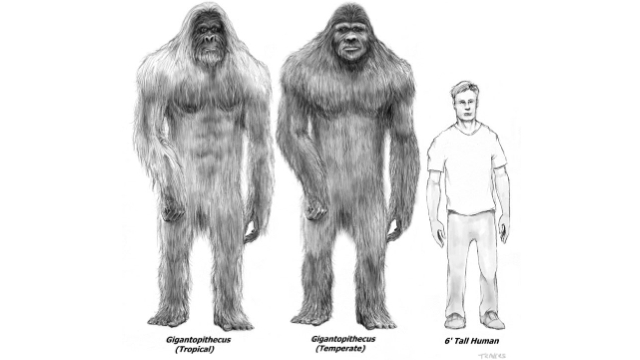
Using the data above, we can assume that from a track that is 20 inches long and 4 inches deep which has 5 toes without claws, our mysterious creature would be 11 feet tall and weigh about 400 pounds.  It is estimated that Gigantopithicus was about 10 feet tall, and weight 1200 pounds.  In comparison, male gorillas generally top out at about 400 pounds and 5 and a half feet tall.  It would seem then that our Sasquatch should be relatively tall and thin. Alternately, if we estimate size based on the creature’s weight  (as estimated above) rather than length of foot and our control is a “fit human male” at 6 feet, 200 pounds, then we would expect our bigfoot to be about 12 feet tall.  In either case, the bulky illustrations we see of purported Sasquatch do not fit.

Witness testimony places much more bulk on our Sasquatch—broader at the shoulders than a man, so different musculature would be present and this would vary the weight considerably.  Factoring in all three—height, weight, and bulk, it would seem appropriate to believe that a male bigfoot would be about 9 or 10 feet tall and weigh in the neighborhood of 800 pounds.

A more accurate estimate of height comes from measuring stride, but we’ll talk more about that when we work our way up to his legs.

Feet have basically two purposes—movement and weight bearing.  The Sasquatch casts show a clear ball and heel, and some casts show an arch.  The larger first toe gives clues to his ability to move.  This larger toe is stronger and we depend on it for propulsion.  In most casts, this first toe is not significantly larger than the rest which would lead us to believe that all toes on this creature assist with propulsion, making movement very fast.  Human feet have three arches, the one we most commonly refer to as “the arch” at midfoot, one along the outer edge, and a “transverse” arch that runs perpendicular to these other two.  All of these arches assist in balance, and generally the “flatter” the arch, the more contact the foot has with the ground.  In the casts above, the arches are barely noticeable.  This should mean that there is a difference in the bone and muscle structure in a Sasquatch foot.  Such flat feet would render a human in great pain and limited mobility and we’re pretty certain that is not the case with Sasquatch.  The Sasquatch is thought to have a mid-tarsal break, which unlike humans would give it enough flexibility to grab objects with its foot.  Additonally, Sasquatch has a gray pad on the sole of the foot called the Ostman pad.

Understanding the Sasquatch foot would be important in placing the creature into comparison with human evolution.  W E H Harcourt-Smith and L C Aiello write:
In the last 80 years or so there have been a number of proposed theories addressing the evolution of hominin bipedalism from the point of view of comparative anatomy. Historically, these theories can be placed into two categories. First, there are those theories based primarily on observed anatomical differences between extant hominoid taxa, and secondly there are those theories based more on fossil material. Because the vast majority of early hominin fossil remains have been found since the 1960s, theories prior to that date rested almost exclusively on the comparative anatomy of modern humans and the extant primates, particularly the great apes. They addressed the question of the probable postcranial morphology and associated locomotor repertoire that immediately preceded the appearance of hominin bipedalism. By contrast, ideas about the evolution of hominin bipedalism since the 1960s have tended to be highly influenced by fossil finds and to focus on questions of bipedal evolution within the human clade.
Sasquatch feet do not fit nicely into any evolutionary delineation.  Perhaps we are dealing with a descendent of the Red Deer Cave People or even an undetermined new hominid species.

Next up-“If you don't have a leg to stand on, you can't put your foot down.” ~Robert Altman


Monday, 19 March 2012

Myth, Legend, or Cryptozoology?


There is a fine line between myth and legend.  Traditional dictionary sources draw that line at “supernatural” or “paranormal” but those words themselves are gray areas.

The Free Dictionary (freedictionary.com) defines Myth as “A traditional, typically ancient story dealing with supernatural beings, ancestors, or heroes that serves as a fundamental type in the worldview of a people, as by explaining aspects of the natural world or delineating the psychology, customs, or ideals of society.”  By this definition, most sea and lake “monsters” would be considered myth, as they are generally fundamentally the same and are ancient in origin.  But the same source gives this definition for legend:  An unverified story handed down from earlier times, especially one popularly believed to be historical.  Lake monsters would fit that definition as well.  The one thing both definitions have in common is that the stories (reports) are “unverified”.

Just what constitutes verification?  Certainly the Sasquatch fits both legend and myth definitions, but since footprints and various other bits of “evidence” are present, does that make them verified?  It would seem that the presence of footprints verifies that something indeed walked in a particular location.  How do we assign the print to Sasquatch?  What is it about that print that points to a legendary or mythological being rather than a verifiable, biological creature?  Which brings up another big question; must an entity be biological to be “real”?

Such is the nature of the study of Cryptozoology.  Many legendary and mythological creatures have been verified to exist biologically.  The Coelacanth, the Komodo Dragon, and the Giant Squid were ancient legends—believed by many to be actually myths—and have now be substantiated by tangible evidence.
George M. Eberhart has written of the difficulties of categorizing “mystery animals”.   He gives us ten types of mystery animals that would be defined as cryptozoological.

1.     Distribution anomalies [known animals reported outside their normal  range, e.g. the anomalous big cats of the U.K.];
2.     Undescribed, unusual, or outsized variations of known species [e.g. the giant anacondas reported from Amazonia or the spotted lions of East Africa];
3.     Survivals of recently extinct species [e.g. Ivory Billed Woodpecker presumed extinct ca. 1960, or the Steller's Sea Cow presumed extinct ca. 1770, both of which are occasionally claimed to have survived to the present];
4.     Survivals of species known only from the fossil record into modern times [e.g. the mokele-mbembe of central Africa, sometimes described as a living dinosaur];
5.     Lingerlings, or survivals of species known from the fossil record much later into historical times than currently thought [e.g. the woolly mammoth, presumed extinct ca. 12,000 BCE but occasionally purported surviving into later eras];
6.     Animals not known from the fossil record but related to known species [e.g. the Andean wolf or the striped manta-ray reported by William Beebe in the 1930s];
7.     Animals not known from the fossil record nor related to any known species [e.g. North America's Bigfoot or most sea serpents];
8.     Mythical animals with a zoological basis [e.g. the Griffin, partly inspired by dinosaur fossils of Central Asia];
9.     Seemingly paranormal or supernatural entities with some animal-like characteristics [e.g. Mothman, Black Dogs or some fairies from folklore];
10.     Known hoaxes or probable misidentifications [e.g. the Jackalope, an antlered rabbit created as a hoax or prank, but possibly inspired by rabbits infected with Shope papilloma virus, which causes antler-like tumors].

Eberhart also gives us a good list of exclusions for classification—or more simply, things that probably are NOT cryptozoological.

1.     Insignificance. "Cryptids must be big, weird, dangerous or significant to humans in some way."
2.     Lack of controversy. "Someone needs to observe a mystery animal and someone else needs to discredit the sighting. Cryptozoologists function as interventionists between witnesses and skeptical scientists."
3.     Erratics. "The out-of-place alligator […] that turns up in an odd spot, undoubtedly through human agency, is not a zoological mystery […] [I]f someone discovers a new species of alligator that lives only in sewers, that is a different matter."
4.     Bizarre humans [e.g. zombies]
5.     Angels or demons […] "the paranormal or supernatural is admitted only if it has an animal shape (a werewolf sighting, which might involve a real dog or wolf, or a mystery canid)."
6.     Aliens "[unless such extraterrestrials] arrived a long time ago and thus classify as residents."

Mr. Eberhart is a bibliographer and librarian for CUFOS (Center for UFO Studies). He completed a degree in journalism at the Ohio State University, then came to the University of Chicago for a Masters in Library Science.. He is employed by the American Library Association headquarters in Chicago as editor for the trade journal American Libraries. He belonged to a natural history book club, and in 1959,  read On the Track of Unknown Animals by Bernard Heuvelmans.  Eberhart’s book “Mysterious Creatures: a Guide to Cryptozoology” can be previewed on Google Books and purchased from Amazon for about $190.00.

To some, it may seem a matter of semantics.  If cryptozoology is to progress out of the label of “fringe science”, however, these definitions and criteria have to be made and widely accepted by serious researchers.  It isn’t enough to go on a “bigfoot hunt” and call oneself a cryptozoologist.