The Centre for Fortean Zoology was founded in the UK in 1992 - nearly 20 years ago. Over the past two decades it has expanded to become a truly global organisation. We opened our American office in 2001, our Australian office in 2009, and now - in our 19th year - we are proud to welcome CFZ Canada to the CFZ global family.

Saturday, 31 March 2012

Sasquatch –from the Bottom up part 2; Hot Legs


So far, all we have as “evidence” for the legs of the Sasquatch are witness testimony and some grainy images.  This makes learning about the anatomy of the legs of the beast a challenge-and doesn’t leave any theories a leg to stand on.

From images and descriptions, it would appear that like humans, the Sasquatch legs are approximately half of the total height.  Because the creature is said to run, we know it must possess at least knees and hips.  This should mean that the basic musculature of a sasquatch leg is much like that of a human.  The knees should bend only one way, and the pelvis supports forward and backward extension.  We do not have any evidence that the Sasquatch can extend its leg sideways from the body, but the lack of such evidence does not mean it cannot make that movement.

Because Sasquatch is apparently bipedal, we will limit the term “legs” to be his lower appendages only.  These would terminate in the feet, addressed earlier.  Like feet, legs assist in weight bearing and locomotion.  In some animals, they also assist in subduing prey.  This does not appear to be the case in Sasquatch, although no evidence either way is currently present.  It would appear that the Sasquatch leg would have at least one femur and one tibia, or bones that are similar to those in humans.   For our purposes we will include the thigh, knee, and ankle as part of the leg, although typically in human anatomy discussion the “leg” is only the area between the knee and the ankle.

In Sasquatch depiction, the leg is in full alignment, meaning that from the hip to the ankle, the leg forms a relatively straight line.  Additionally, the legs appear to be more muscular than the arms.  This is a distinct difference from gorillas, as their forelegs (arms) are very much stronger than their legs.  This is largely due to weight distribution.  Bipedal animals (humans) need to have the bulk of their weight distributed over only two appendages, where the apes put weight on all four.  These traits suggest that Sasquatch is primarily a ground dweller.  If he spent a large amount of time in trees his legs would show a bit of a bow, to allow for better attachment to the tree limb allowing fuller balance.  This should not be misinterpreted to mean that the Sasquatch cannot climb.  Certainly human anatomy allows for climbing and it should be assumed that Sasquatch would be capable of that as well.  Some videos do depict presumed Sasquatch in trees.
Sasquatch appears to move with what is called a “compliant gait”, meaning the knees and elbows are bent as it walks.  Unlike humans, bigfoot has little “up and down” motion in his gait, and raises his heel significantly in his stride.  His stride is considered “in line” meaning that one foot is nearly directly behind the other.  Die hard believers consider the stride evidenced in the Patterson-Gimlin film as conclusive, but a Stanford study showed that humans can in fact mimic the gait shown in the film.
Several bigfoot clips show the animal dropping to all four appendages when startled.  Like an ape, it uses its feet instead of a knee like a human would.  In films where the subject appears to jump, it is an inline stride jump rather than a broad jump.

The mathematical formula for average stride length in a human male is .415 times his height in inches. To reverse diagnose that, we can take a sasquatch stride (usually about 600 mm or 23 inches) and divide by .415.  This would make the creature in the Patterson-Gimlin film only 55 inches tall. (note that a “stride” is defined by the distance from the heel of one foot to the second occurrence of that same heel—or two full steps).  Some analysts of the film put him at 78 inches.  In the first example, this would put our Sasquatch in the relative size of Australopithecus, long thought to be either an ancestor of big foot  or the actual species.  In the second example it would put the beast in the realm of  Paranthropus, another candidate for the lineage.  In both cases, the heights are well below legendary reports of 7 and 8 foot beasts.


There may be real answers coming.  Craig Woolheater reported in 2006 that Tom Biscardi has access to a bigfoot corpse, buried on a reserve in Manitoba.  But then, on Biscardi’s website you can go “shopping for Bigfoot” and for only $35 can get a “Bigfoot Welcome Mat”.  There is also the “Erikson Project”, the work of Adrian Erikson.  Erikson waffles on whether or not he has access to actual Sasquatch remains, but says he has seen one, and “they walk like runway models”.  For now, anecdotal evidence is all we have toward solving this mystery.
 

American Journal of Physical Anthropology
Volume 28, Issue 2, pages 163–181, March 1968
Primate anatomy : an introduction,          Friderun Ankel-Simons, Elsevier Academic Press, ©2007.
Bigfoot exposed: an anthropologist examines America's enduring legend
 By David J. Daegling

Friday, 23 March 2012

Sasquatch –from the Bottom up part 1; Big Feet


I’m still pretty green at this Crypto stuff—I’ve only been part time studying for about 6 years.  My “real job” is researching hauntings phenomena and Cryptozoology is sort of a side.  I’ve decided to share my learning journey here on this blog, beginning with Sasquatch.

Today we’re looking at Bigfoot’s feet.  Most footprint casts look like this:


Most notably, each of these images appears to have five toes.  Racoons have five toes, but there would be evidence of claws in the tracks.  Bears also have five toes, but the front tracks have a short sole.  The hind track is a bit larger.  Both are wider near the toe than the above tracks.  Note too that there are no signs of claws on any of these casts.  An animal large enough to leave these prints would step deeply enough to leave signs of any claw attached.
These tracks appear most closely related to human tracks, but is that enough to classify bigfoot as humanoid?  Not just the tracks.  When we add in the probability that whatever made the tracks walks upright, this lends a better probability that this creature is structurally much like a human.

From the footprint casts we can also deduct relative weight and height.  The depth of the imprint is indicative of the weight of the creature who made it.  This is fairly easy to determine in the field.  Choose an investigator with a similar size footprint (or the largest one available) and have that person run barefoot over the same area where the cast was taken (given the same level of wetness of the soil or snow).  Measure that footprint’s depth and add the subject’s known weight into this formula:
Depth of human track/weight of human=depth of unknown/x where x equals the weight of the unknown.
More specifically, if you have a 3 inch depth on your 200 pound human (3/200) and a 4 inch depth on your unknown (4/x) you can solve for the weight as such:  3/200=4/x or 3x=1200, meaning x would be 1200/3 or 400 pounds.  This works much more accurately than analysis of the Patterson-Gimlin tracks where the tracks were compared to horse tracks.  Clearly, the weight distribution is different on a hooved animal with four weight bearing limbs than on a five toed bipedal animal.

Because of the structure of the human foot, it is easy to approximate the height of the person it belongs to.  Keep in mind that this does not allow for deformation like spinal compression or curvature, so the height is not exact.  Deducing this is to get a general idea of how large a creature would be. In humans, the length of a person's foot is approximately 15 percent of his or her height.  The formula is 15/100=foot inches/height inches.  So if a man has a 10 inch foot you can expect him to be about 67 inches tall.  15/100=10/x where x is his height becomes 1000=15x or about 67 inches.  If the cast length is 20 inches, you should expect your creature to be no more than 133 inches or about 11 feet tall. 
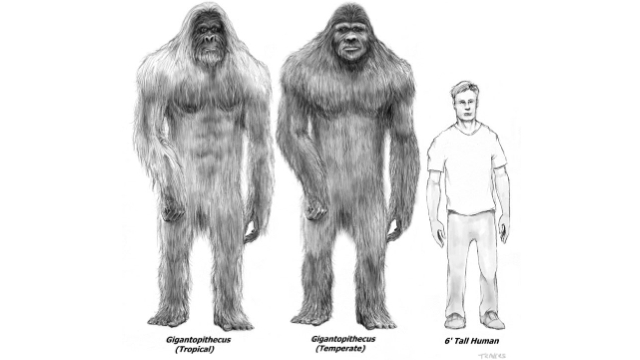
Using the data above, we can assume that from a track that is 20 inches long and 4 inches deep which has 5 toes without claws, our mysterious creature would be 11 feet tall and weigh about 400 pounds.  It is estimated that Gigantopithicus was about 10 feet tall, and weight 1200 pounds.  In comparison, male gorillas generally top out at about 400 pounds and 5 and a half feet tall.  It would seem then that our Sasquatch should be relatively tall and thin. Alternately, if we estimate size based on the creature’s weight  (as estimated above) rather than length of foot and our control is a “fit human male” at 6 feet, 200 pounds, then we would expect our bigfoot to be about 12 feet tall.  In either case, the bulky illustrations we see of purported Sasquatch do not fit.

Witness testimony places much more bulk on our Sasquatch—broader at the shoulders than a man, so different musculature would be present and this would vary the weight considerably.  Factoring in all three—height, weight, and bulk, it would seem appropriate to believe that a male bigfoot would be about 9 or 10 feet tall and weigh in the neighborhood of 800 pounds.

A more accurate estimate of height comes from measuring stride, but we’ll talk more about that when we work our way up to his legs.

Feet have basically two purposes—movement and weight bearing.  The Sasquatch casts show a clear ball and heel, and some casts show an arch.  The larger first toe gives clues to his ability to move.  This larger toe is stronger and we depend on it for propulsion.  In most casts, this first toe is not significantly larger than the rest which would lead us to believe that all toes on this creature assist with propulsion, making movement very fast.  Human feet have three arches, the one we most commonly refer to as “the arch” at midfoot, one along the outer edge, and a “transverse” arch that runs perpendicular to these other two.  All of these arches assist in balance, and generally the “flatter” the arch, the more contact the foot has with the ground.  In the casts above, the arches are barely noticeable.  This should mean that there is a difference in the bone and muscle structure in a Sasquatch foot.  Such flat feet would render a human in great pain and limited mobility and we’re pretty certain that is not the case with Sasquatch.  The Sasquatch is thought to have a mid-tarsal break, which unlike humans would give it enough flexibility to grab objects with its foot.  Additonally, Sasquatch has a gray pad on the sole of the foot called the Ostman pad.

Understanding the Sasquatch foot would be important in placing the creature into comparison with human evolution.  W E H Harcourt-Smith and L C Aiello write:
In the last 80 years or so there have been a number of proposed theories addressing the evolution of hominin bipedalism from the point of view of comparative anatomy. Historically, these theories can be placed into two categories. First, there are those theories based primarily on observed anatomical differences between extant hominoid taxa, and secondly there are those theories based more on fossil material. Because the vast majority of early hominin fossil remains have been found since the 1960s, theories prior to that date rested almost exclusively on the comparative anatomy of modern humans and the extant primates, particularly the great apes. They addressed the question of the probable postcranial morphology and associated locomotor repertoire that immediately preceded the appearance of hominin bipedalism. By contrast, ideas about the evolution of hominin bipedalism since the 1960s have tended to be highly influenced by fossil finds and to focus on questions of bipedal evolution within the human clade.
Sasquatch feet do not fit nicely into any evolutionary delineation.  Perhaps we are dealing with a descendent of the Red Deer Cave People or even an undetermined new hominid species.

Next up-“If you don't have a leg to stand on, you can't put your foot down.” ~Robert Altman


Monday, 19 March 2012

Myth, Legend, or Cryptozoology?


There is a fine line between myth and legend.  Traditional dictionary sources draw that line at “supernatural” or “paranormal” but those words themselves are gray areas.

The Free Dictionary (freedictionary.com) defines Myth as “A traditional, typically ancient story dealing with supernatural beings, ancestors, or heroes that serves as a fundamental type in the worldview of a people, as by explaining aspects of the natural world or delineating the psychology, customs, or ideals of society.”  By this definition, most sea and lake “monsters” would be considered myth, as they are generally fundamentally the same and are ancient in origin.  But the same source gives this definition for legend:  An unverified story handed down from earlier times, especially one popularly believed to be historical.  Lake monsters would fit that definition as well.  The one thing both definitions have in common is that the stories (reports) are “unverified”.

Just what constitutes verification?  Certainly the Sasquatch fits both legend and myth definitions, but since footprints and various other bits of “evidence” are present, does that make them verified?  It would seem that the presence of footprints verifies that something indeed walked in a particular location.  How do we assign the print to Sasquatch?  What is it about that print that points to a legendary or mythological being rather than a verifiable, biological creature?  Which brings up another big question; must an entity be biological to be “real”?

Such is the nature of the study of Cryptozoology.  Many legendary and mythological creatures have been verified to exist biologically.  The Coelacanth, the Komodo Dragon, and the Giant Squid were ancient legends—believed by many to be actually myths—and have now be substantiated by tangible evidence.
George M. Eberhart has written of the difficulties of categorizing “mystery animals”.   He gives us ten types of mystery animals that would be defined as cryptozoological.

1.     Distribution anomalies [known animals reported outside their normal  range, e.g. the anomalous big cats of the U.K.];
2.     Undescribed, unusual, or outsized variations of known species [e.g. the giant anacondas reported from Amazonia or the spotted lions of East Africa];
3.     Survivals of recently extinct species [e.g. Ivory Billed Woodpecker presumed extinct ca. 1960, or the Steller's Sea Cow presumed extinct ca. 1770, both of which are occasionally claimed to have survived to the present];
4.     Survivals of species known only from the fossil record into modern times [e.g. the mokele-mbembe of central Africa, sometimes described as a living dinosaur];
5.     Lingerlings, or survivals of species known from the fossil record much later into historical times than currently thought [e.g. the woolly mammoth, presumed extinct ca. 12,000 BCE but occasionally purported surviving into later eras];
6.     Animals not known from the fossil record but related to known species [e.g. the Andean wolf or the striped manta-ray reported by William Beebe in the 1930s];
7.     Animals not known from the fossil record nor related to any known species [e.g. North America's Bigfoot or most sea serpents];
8.     Mythical animals with a zoological basis [e.g. the Griffin, partly inspired by dinosaur fossils of Central Asia];
9.     Seemingly paranormal or supernatural entities with some animal-like characteristics [e.g. Mothman, Black Dogs or some fairies from folklore];
10.     Known hoaxes or probable misidentifications [e.g. the Jackalope, an antlered rabbit created as a hoax or prank, but possibly inspired by rabbits infected with Shope papilloma virus, which causes antler-like tumors].

Eberhart also gives us a good list of exclusions for classification—or more simply, things that probably are NOT cryptozoological.

1.     Insignificance. "Cryptids must be big, weird, dangerous or significant to humans in some way."
2.     Lack of controversy. "Someone needs to observe a mystery animal and someone else needs to discredit the sighting. Cryptozoologists function as interventionists between witnesses and skeptical scientists."
3.     Erratics. "The out-of-place alligator […] that turns up in an odd spot, undoubtedly through human agency, is not a zoological mystery […] [I]f someone discovers a new species of alligator that lives only in sewers, that is a different matter."
4.     Bizarre humans [e.g. zombies]
5.     Angels or demons […] "the paranormal or supernatural is admitted only if it has an animal shape (a werewolf sighting, which might involve a real dog or wolf, or a mystery canid)."
6.     Aliens "[unless such extraterrestrials] arrived a long time ago and thus classify as residents."

Mr. Eberhart is a bibliographer and librarian for CUFOS (Center for UFO Studies). He completed a degree in journalism at the Ohio State University, then came to the University of Chicago for a Masters in Library Science.. He is employed by the American Library Association headquarters in Chicago as editor for the trade journal American Libraries. He belonged to a natural history book club, and in 1959,  read On the Track of Unknown Animals by Bernard Heuvelmans.  Eberhart’s book “Mysterious Creatures: a Guide to Cryptozoology” can be previewed on Google Books and purchased from Amazon for about $190.00.

To some, it may seem a matter of semantics.  If cryptozoology is to progress out of the label of “fringe science”, however, these definitions and criteria have to be made and widely accepted by serious researchers.  It isn’t enough to go on a “bigfoot hunt” and call oneself a cryptozoologist.

Wednesday, 22 February 2012

Danger in the Field

Those of us who do field work are often subjected to interesting situations; sometimes even dangerous ones.  Too often, the dangers are not anticipated.  In fact, sometimes the dangers don't even make sense.  This is the case with the recent death of Jeff Rice and injury to Catherine Fuller.  While not "cryptozoologists", these two certainly qualify as field researchers.

You may have heard of Jeff and Catherine because of their ties to "Destination Truth", a popular SyFy Channel/SPACE Canada series hosted by Josh Gates.  Josh and crew take on lots of things paranormal and exciting, often exploring cyrptozoological topics.Jeff and Catherine were "facilitators".  These are the people who make the onsite stuff possible.  They coordinate local sites, talent, permissions, equipment, and all manor of tidbits that allow shows like this to be filmed on location.  Last week the pair were in Uganda and were apparently attacked in their hotel room and poisoned with ingested cocaine.  Details are still coming in. This highlights, though, a certain need for caution when working in the field--in any capacity, but certainly in the jungles and woods of foreign lands.

Generally, cryptids do not make themselves available in the researcher's home town.  Investigating them may mean travel and finding accommodations. Often the travel is to countries that have a level of unrest that would make it dangerous to go there.  The Canadian government (and most other governments) publish a list of countries they feel might be dangerous.  Some top crypto destinations are on Canada's list.  Burma (Myanmar) has a recent primate sighting that may be new and the Canadian government rates travel there as a high risk because of civil unrest.  China, Indonesia, Kenya, Russia, and Thailand all have warnings on Canadian travel.  Non-essential travel to Burundi, home of the giant man-eating crocodile, is highly discouraged.

There are, however, more mundane dangers in the field.  None of us should go "in search of" without a few basics.  Here's a short list, and if you have additional safety items to suggest please list them in the comments.

Elastic Bandages-sprains happen
Snake bite kit-unless of course you are going to Ireland or Hawaii
Afterbite-because cryptomosquitos can be nasty
Antihistamines-it's hard to focus when your eyes are watery
Various size wound dressings-for ouchies
Antibiotic Ointment
Water
Nutrition bars
Cold packs
Scissors
needle and thread--because in an emergency, more than your pants might need a stitch
matches/lighter
aspirin/tylenol

You should already be carrying these items in your investigative kit, but here are some first aid uses:
non-latex gloves-in addition to helping keep things clean, these can be tied together for a tourniquet
long nosed tweezers-for stingers and splinters
tongue depressors-for splints
tape
sunscreen
Short wave or CB radio or cell phone (if there is service!)

Granted these things probably won't help you in a war zone.  Heed the travel cautions.  Arm yourself with extensive knowledge about where you are going. Get permission from the land owner or government before you set foot on someone's property or camp in a park.

Common sense may not have saved Jeff Rice's life, but it just might save yours or the life of a member of your team.


http://www.cryptomundo.com/cryptozoo-news/rice-obit/
http://www.syfy.com/destinationtruth/
http://www.voyage.gc.ca/countries_pays/menu-eng.asp
http://forteanzoology.blogspot.com/2009/03/more-on-man-eater-from-burundi.html
http://www.the-fitness-motivator.com/field-first-aid.html


Sunday, 19 February 2012

Caddy Debunked?


Most Canadians (and Cryptogeeks worldwide) are familiar with Vancouver’s Cadborosaurus.  It was named after Cadboro Bay on the southern tip of Vancouver Island.  A classic sea serpent, Caddy is said to have a horse-like head, a flowing mane on a long curved neck, and a long thing snake-ish body that reveals several loops above the surf.

The website skeptic.com claims that it first surfaced in 1933, “the same year the Loch Ness monster became world famous.”  The website credits editor Archie Wills, of the Victoria Daily times, as the person who invented Caddy.  According to skeptics, he was looking to distract readers from tense subjects like the depression and Hitler.  Archie was the City Editor at that time (1928-1936).  This claim is uncited, and I have been unable to find a reputable source for this item.

Ed Bousfield and Paul LeBlond have researched Caddy for over 20 years.   They have recommended that Caddy animals be classified as Caborosaurus willsi in accordance with the rules of International Code of Zoological Nomenclature in honor of Wills.  They state that he “devoted many column inches to the creature and vigorously amassed a myriad sighting reports of the creature's activities”.

Who to believe?  Respected scientists Bousefield and LeBlond or noted skepdebunkers from skeptic.com seem to have different opinions.  The answer is simple.  To debunk the claim that Archie Wills invented the Cadborosaurus we simply need to show a sighting report prior to 1933.  He may indeed have invented the NAME “Cadborosaurus” but did he invent the creature as the skeptics suggest?

It seems unlikely that Archie in fact “invented” the monster.  On his way to Greenland in July 6 of the year 1734, Norwegian missionary Hans Egede reported that he saw "a very terrible sea-animal which raised itself above the water." This sighting is often considered one of the first “Caddy sightings” but in fact this one occurred off the shore of Greenland, nowhere near Vancouver Island.  In an article in Raincoast Chronicles , journalist Howard Wright recounts Hubert Evans’ 1932 sighting.  More compelling, however, are petroglyphs from the area depicting what appear to be sea monsters.  Natives refer to this creature as a “sea wolf” or Haida.  The descriptions are very similar.  Mr. Wills did not invent those.


As for the skeptic reference to the “Loch Ness Monster”, they again skew the facts, presumably to support their agenda of nonbelief.  The first documented sighting at Loch Ness was in 565 AD.  What occurred in 1933 was the first modern sighting, attributed to a Mr. and Mrs. Spicer, who wrote of the thing in a letter.  The first photograph of Nessie did not happen until 1934.  Sightings increased after 1933 not because Nessie first appeared, but rather because that is when the first road was built and more people came to the area. While the skeptics may be technically correct that Nessie became known worldwide sometime in the August 1933-November 1934 range, it was well known among the locals for centuries prior.

Regardless of when the term was coined or the first sightings took place, Caddy continues to be spotted in BC waters.  In fact, there have been more than 300 sightings in the last 200 years.  We are currently in “Caddy Watching Season (October to April) so perhaps someone will send us a current report.


Sunday, 12 February 2012

On Being a "Cryptozoologist"

It's not rocket science, that's for sure.  It isn't pseudoscience either, at least as far as I'm concerned.  Lately though, I've been asking myself "What exactly is a Cryptozoologist and why do people think I am one?"

Lately this blog has been getting comments from notables like Loren Coleman, Dale Drinnon, and Dr. Karl Shuker.  This is very humbling and not a little distressing.  I never intended to be a Cryptozoologist, nor do I consider myself any sort of authority on mystery animals.  What I am is a student.  I take the study very seriously, and although I may not always get everything "right", I do a LOT of research and try to present interesting topics in a fair and balanced way.  As a Southern Girl, this isn't always easy, as, and my colleagues will definitely agree, I am an extremely opinionated person!  I have strong beliefs about what some of these creatures are.  I am, however, smart enough to know I'm not the final answer to what's out there.  I study Cryptids.  I learn every day.

That, in a nutshell, is what makes me a Cryptozoologist.  By its simple etymology, the word "cryptozoology" is the study of unknown animals; and those who participate in cryptozoology are, by definition, cryptozoologists.  We are also biologists, theorists, historians, archaeologists, zoologists, and so much more.  We are these things because we study, not because we make discoveries or prove theories.  Sometimes those things do happen, but cryptozoology is simply a study.  I am sort of a fifth grade student.  I have been diligently studying unknown animals for about five years.  I also happen to have seen what I believe to be "mothman" and have done fieldwork in West Virginia, Ohio, New Jersey, and Ontario.  I did/do this not as a PhD or scholar.  I do consider myself a scientist.

The title "scientist" is another controversial one in the studies of things paranormal.  In The Journal of Theoretics, science is defined as the "the field of study which attempts to describe and understand the nature of the universe in whole or part."  The definition does not suggest one must be learned, or respected, or lettered.  Science only requires study.  Anyone can be a scientist.  Most of us are, every day, in some form. Most people are not scientists with an agenda of being "noted" or "famous".  Most are just curious individuals who like to research and learn.  I am one of those people.


How can Cryptozoology, then, be a "pseudoscience"?  This would imply that those of us who study cryptids aren't really studying, but pretending to study.  None of  my colleagues in this field sit in laboratories, forests, or libraries listening to iPods with a comic tucked into a textbook.  We are really looking, really learning, and really trying to understand and document all of the oddities around us.  I would also assert that pseudo-skeptics are also cryptozoologists when they try to disprove the existence of such oddities.  After all, something must be studied to be debunked.  This is where the "pseudoscience" label fails.


We must be papered, lettered, and recognized before our study and research has any value,  just like some of the most revered scientists of the past, right?  Wrong.  Aristotle was a philosopher yet he set the stage for what would eventually develop into the scientific method centuries later. Charles Darwin failed miserably in learning medicine (at age 16, no less) and attended Cambridge at a time when there was no degree in the natural sciences.  Thomas Alva Edison quit school in 1859, at the age of 12, yet is considered one of the foremost scientists of modern time.  Sir Isaac Newton, the epitome of a scientist, made many of his discoveries well before earning his Bachelors Degree in 1665.  In fact, in his own lifetime, Newton wrote more on religion than he did on natural science.  He also devoted a great deal of time to alchemy.


I don't aspire to be in the same realm as the geniuses above, including our modern Cryptozoologists.  I have enjoyed a modicum of notoriety in the field and am publishing not only here on the blog and other online outlets, but also in print books (most of which are still in process). I am regularly asked to be interviewed on various cryptid topics as well as haunting phenomena.  These are honors I am always surprised to receive as I truly consider myself simply a student.  One of the things I  have learned is that I do in fact "deserve" to wear the title "Cryptozoologist"--as do you, if you are a student of mystery animals.  I wear it proudly, but not arrogantly.  I'll leave arrogance to those who decry why I devote myself  to as "pseudoscience" and declare that we, as a group, are not "credible".


This from Loren Coleman says it all, "Being a cryptozoologist is to be a modern adventurer..."

http://www.journaloftheoretics.com/editorials/vol-1/e1-3.htm
http://www.crystalinks.com/newton.html
http://answers.yahoo.com/question/index?qid=20110218014126AAE7BRJ
http://www.cryptomundo.com/cryptozoo-news/cz-career/

Sunday, 5 February 2012

Underwater Mystery Cat


Native North Americans have a long tradition of stories regarding the Mishibizhiw, an underwater panther.  Some tribes, particularly Anishinaabe, Odawa, Ojibwe, and Potawatomi, of the Great Lakes region of Canada consider this being as the most powerful underworld being.  The Ojibwe held them to be the master of all water creatures.  Some myths include this water lynx in their creation legends.


 In the Ojibwe language, this creature is called "Mishibizhiw", "Mishipizhiw", "Mishipizheu", "Mishupishu", "Mishepishu", "Michipeshu", or "Mishibijiw", which translates as "Great Lynx," or Gichi-anami'e-bizhiw ("Gitche-anahmi-bezheu"), which translates as "the fabulous night panther."  Often, it is referred to as the "Great underground wildcat" or "Great under-water wildcat."  In Lake Superior Provincial Park on Ontario, there are pictographs of a mishibizhiw and two giant serpents.  These creatures were described as water monsters that live in opposition to the Thunderbirds which are masters of the powers of the air.

With the body of a cat, usually like a lynx and the horns of a deer, it also sports scales on it’s back and sometimes even bird feathers.  They typically are sporting long tails.  Like many other creatures in native lore, it is said to be a shape shifter.  It is said they roar or hiss like the sound of rushing water. Mishipizheu were said to live in the deepest lakes and rivers and can cause storms.  Other traditions claim they can sometimes be helpful and protective, but generally they are viewed as bringing death or other misfortune.  Traditionally, offerings are made to help with safe passage across the water.
"While skirting some rocks, which by their height and length inspire awe, we saw upon one of them two painted monsters which at first made us afraid, and upon which the boldest savages dare not long rest their eyes. They are as large as a calf: they have horns on their heads like those of a deer, a horrible look, red eyes, a beard like a tiger's, a face somewhat like a man's, a body covered with scales, and so long a tail that it winds all around the body, passing above the head and going back between the legs, ending in a fish's tail."
—French missionary Jacques Marquette, 1637
It was a widely held belief that copper came from the creature and charms were made to bring luck to hunters.  After the hunt, these charms would be destroyed.  Native Canadian preferred guns with brass plates depicting European dragons; they likely were interpreted to be images of Mishepishu. An Anishnaabe Ojibwa club from around 1800 has a Mishepishu figure on the end closest to the blade. In 2011, one of the Canadian Mint Mythical Creatures coins depicted a Mishepishu.  The Canadian Museum of Civilization includes an underwater panther in its coat of arms.  While often depicted in both ancient and modern art, modern sightings are virtually nonexistant.