The Centre for Fortean Zoology was founded in the UK in 1992 - nearly 20 years ago. Over the past two decades it has expanded to become a truly global organisation. We opened our American office in 2001, our Australian office in 2009, and now - in our 19th year - we are proud to welcome CFZ Canada to the CFZ global family.

Wednesday, 7 August 2013

Give Us Some Real Evidence

Oh Sasquatch Ontario (aka Mike Patterson)....you disappoint us.


I'll give you that the audio is interesting.  Even entertaining. But proof?  Hardly.

First, no location is given.  Now, I live in Ontario and I know when it starts getting light enough to see on August 2.  I'm not buying that you could see nothing at all.  Tell us your approximate location and we'll verify your dawn time and the weather on that day.

Second, the recording is pretty darned clear.  Unless the animal was right on the mike, there should be much more ambient sound and a bit of measurable echo.  Could we hear it raw please?  And certainly without the set up commentary that is very leading.

Third, a name?  Really?  From this piece, you're proposing that this particular Bigfoot has graced your recording with its name.  You suggest this has happened because you have become so friendly with the phenomena that there is a dialogue.  You have been asking for a name, and the Sasquatch was not only comfortable with your audible presence but also understands English and is capable of responding to your request.

I won't go so far as to accuse these folks of hoaxing.  I would suggest, however, that youtube.com is not the best place to release a "discovery of biblical proportions."  Further, this "evidence" fails to meet the most basic standards--qualify, quantify and qualityassure.

Tim Ervick, among many others, is going out of his way to distance himself from Patterson, saying,
First off he has no connection to Ontario Wildlife Field Research run by myself and no connection to Ontario Bigfoot or Ontario Sasquatch groups. These are well established groups that would never endorse or knowingly participate in such an obvious hoax. 
Mike P has a burden of proof that some have mentioned to him only to be answered with his arrogant and condescending attitude. Serious red flags to anyone serious on the subject.

And from Tim Fasano,
I suspected from the beginning these guys were running scam. They were finding Bigfoot evidence on EVERY trip into the woods. HINT: when finding Bigfoot seems as easy as finding animals at a zoo, that should raise a red flag.
Mike--you seem to be a great wildlife photographer.  Don't quit your day job.

http://bigfootevidence.blogspot.ca/2013/08/sasquatch-ontarioreleases-most.html
http://www.youtube.com/user/MANASOOCAN?feature=watch
http://bigfootevidence.blogspot.ca/2013/05/this-sasquatch-ontario-guy-has-even.html
http://www.sasquatchevidence.com/2013/07/ontario-wildlife-field-research-and-mike-paterson-hoax.html
http://www.sasquatchevidence.com/2013/05/comment-on-sasquatch-ontario.html

Decisions, Decisions...

Is it crypto?  I find myself asking that quite a lot these days.  I work with both hauntings phenomena and cryptozoology and sometimes it is very hard to figure out which is which.

One of my current cases involves a First Nations community in Ontario.  Several things have been reported, some of which are clearly ghostly in nature.  There are a couple, however, that test my theories from the very beginning.  One is a report of “little people”.  We’re not talking about just one or two small-ish folks.  The report is a virtual colony of small humanoids that behave in very human fashion.  They aren’t gnomes, or fairies, or any of the other typical “wee folk”, just pint sized humans.  The reports of this colony go back over 75 years!  Clearly crypto?  Not so fast.  How would we know?  It would seem that the litmus test for cryptozoology would be physical evidence.  If we could find a body, or some other sorts of artifacts, then perhaps this would put this solidly in the crypto category.  Sasquatch, however, has left us no such definitive proof and we still place him in this realm.

Another report in this area is that of a man with hooved feet.  He walks upright and looks into windows.  He also reportedly leaves tracks.  Does his ability to alter the ground in this way make him a cryptid?  And what about “shape shifters”?

Generally, for most cryptozoologists, it comes down to a belief system.  Many think that the idea of ghosts is ridiculous, yet firmly believe in Bessie or the Loch Ness Monster.  Since cryptozoology is generally more of a science based endeavor, skeptics are more likely to lean toward acceptance.  As the research into hauntings continues to blossom, however, more and more scientific method and results are being reported by investigators.

I struggle with this classification system quite a lot with the reports of Mothman specifically.  In this case, there are not only elements of cryptozoology and hauntings, but also strong evidence of UFO involvement.  Should we pick a path and stick to it or would the subject be better served by a team (or a person) of all three specialties?


I’m greatly interested in your feedback on this.  What makes a cryptid a cryptid?


Sunday, 21 July 2013

Gotcha!

I want to state right off the bat that I don't write this to ridicule anyone.

Day before yesterday, a blogger at GhostTheory.com wrote a piece on Sasquatch.  The post has since been completely removed, so I can't tell you who wrote it or what it said, but from the news update I got it appears to have been an excited retelling of a "news" story in The Sage, an online satire from Canada that is quite similar to The Onion.


In the original Sage story, whose headline reads

Alberta: Bow Valley flooding exposes rotting carcass of a Sasquatch.

Legendary Cryptid believed to be a surviving Gigantopithecus,

seems to tell the story of a hiker, northwest of Canmore, Alberta.  This hiker purportedly found the rotting corpse of a "sasquatch" that had been uncovered in the mass flooding in southern Alberta.  The article even goes so far as to quote a "Coren Lowman", noted Cryptozoologist.

The first problem with this story is that it is from The Sage. The website clearly states that it is satire, so either the ghosttheory.com author didn't notice that, or they do not know what satire is.  Additionally, The Sage prints a disclaimer stating the items are "satire and faux" and for humor only.  Sadly, we have become accustomed to this level of research--simply looking at the headlines and briefly scanning content before rebroadcasting.

The second problem is from The Sage.  No, I don't fault them for being creative, it's just that this particular article is not funny.  The flooding in Alberta was devastating.  People lost their homes, their livelihoods, and in some cases, their lives.  This disaster just isn't good fodder for humor, at least not just a few weeks from the event.  To find Alberta Sasquatch humor isn't difficult--Google Todd Standing.

The third problem is a combination of the two.  Just a few days after The Sage ran its story, it was picked up by AboveTopSecret.com, Bigfootblogger.com, and other sites.  Most of those sites made no claim of it being satire or false in any way.  I have to wonder, did they think they were reporting truth?  

This is how legends and hoaxes get started.  Someone thinks they are being funny, or smarter than others and out to fool the world, and starts silliness like this without regard to the serious study OR the locals who have to deal with the fallout.

Let's be a little more responsible than this.  Let's read the whole article, the whole page, the public opinion of a publication or website or get the background of the author before we start playing this game of "telephone" that is corrupt even before the first pass.

It might also be good to remember that if it seems amazing and remarkable, especially in a field that studies the amazing and remarkable, it probably is.


Wednesday, 3 July 2013

Breaking News on the Ketchum DNA

The Huffington Post and The Examiner are both reporting today that the DNA presented by veterinarian Melba Ketchum as Big Foot DNA, is actually opossum.  Houston Chronicle reporter Eric Berger sent some of Ketchum's DNA samples to an independent geneticist for analysis.  It wasn't pretty.

Ketchum told Huffington Post:
"He's just out there to create drama."
"This is unbelievable -- my study is a legitimate study," she said. "There's no credibility in his study whatsoever ... There's jealousy out there."
Ketchum wants a new independent study done to prove her results are solid and Berger's are skewed.  She wants to watch the testing herself because she believes Berger may have switched the samples.  

Nothing like a little Big Foot drama to start the month for fireworks.


http://www.examiner.com/article/sasquatch-dna-actually-found-to-be-opossum-dna
http://www.huffingtonpost.com/2013/07/03/bigfoot-dna-test-results_n_3541431.html

Saturday, 29 June 2013

Finding the Midnight Toker

Last week the Toronto Star (6/20/2013) carried a story about a researcher who was arrested while hunting Sasquatch.  He claims he was “bullied” by an officer of the law.


Let’s look at this.

Last August, Tim Marczenko,  a member of Ontario Wildlife Field Research,  was in the woods near Brock Township, Durham Region, Ontario.  He claims, according to the story, that he is researching suspected Bigfoot tracks in the area.  Additionally, Mr. Marczenko is a media person.  His LinkedIn profile says he is an Executive Assistant at Rhombus Media, Inc. in Toronto.

Constable Aukema dismissed Marczhenko’s story as “bulls--t” and demanded to know if he had an accomplice with him. He then seized a survival knife found in the rental car.  The officer told Mr. Marczenko he’d heard the same Bigfoot story from people arrested for drug crimes in the area. 

“He threatened me many times, saying he was going to tow my car or charge me with trespassing or concealing a weapon,” Mr. Marczenko said. He said that when the officer found the knife in the rental car, “He said I was lucky I didn’t get a gun in my face.”

I wouldn’t call those threats.  Seems like pretty standard stuff to me.

The Durham police reviewed the complaint that Marczenko was treated poorly.  They admitted Mr. Marczenko’s survival knife was seized in error, but found no misconduct on the part of the officer. Mr. Marczenko has appealed that finding to a police oversight agency.  All this because they thought he was a nut?

“I was shocked and insulted by the way they handled my complaint,” he said. “My rights were violated.
“I feel an apology needs to come from the officer and the department for not taking this seriously.”
Ontario Wildlife Field Research has a reported membership of 106.  Two of these are featured on the website, as are some internet radio shows and a YouTube channel.  Mr. Marczenko is not easily found on the site.  In fact, I never did locate a reference to him.

This presents a problem, for if the police had simply checked the website and there had been a list of recognized researchers, his story would have held up. Legitimate researchers leave a paper/internet trail.  If they don’t, then they should be working under someone who does. 

A second problem here is that the “suspicious person” was reported to police by the neighbors.  If he had permission to be on this land, the locals would know it or he would have some sort of written permission to be there.  Otherwise it is called Trespassing, and that is a criminal offense.  Even if the forest was “Crown Lands” or “National Forest”, you have to be there only with permission.  Mr Marczenko was indeed charged with trespassing.

The article states that a “survival knife” was removed by police.  Now, as a field researcher, I can tell you that this is a key piece of equipment to have in the field.  Even a good hiker should carry one.  Why the nice officers confiscated that I do not know nor can I support unless he in some way threatened them.  The article states that vegetation was found in his car…the officers said it looked like marijuana.  Hrmmm.  Why was there vegetation in the car at all?  And was it clearly tagged as evidence for research?  Not likely.  If it were, the officers would have been (or should have been) more respectful.

Mr Marczenko says he was “bullied” by officers.  That the officer called him a liar and accused him of doing something criminal, namely being a marijuana grower.  He was ridiculed for saying he was a Bigfoot Investigator.  Who among us has not been through THAT particular conversation?  Marcello Truzzi (September 6, 1935 – February 2, 2003) was a professor of sociology at New College of Florida and later at Eastern Michigan University.  He was one of the founders of CISCOP (Committee for the Scientific Investigation of Claims of the Paranormal).  He is credited with the quote “Extraordinary claims require extraordinary proof."  Certainly, wandering alone in the forest and claiming to be a Bigfoot Hunter is an extraordinary claim.  It would have served him, and the rest of us, to have shown understanding of the ridicule and provided SOME kind of proof that this was the purpose.

Added further to the problem is that of him having a rental car.  Now, having a rental car isn’t a crime.  It’s not even unreasonable to expect in an out of town investigation of some distance.  This location, however, is not a far distance from his home.  While not damning evidence of wrongdoing, I can see how the police might have found it curious.

Mr Marczenko was doing what is typically called an “onsite investigation”.  He was also doing it badly.  First and foremost, he failed to get permission to be on the property.  Second, he went alone. Third, he went to a location openly known to be the location of illegal enterprise.  Had he bothered to interview any of the locals, as a good researcher would, then he would have known the reputation.  Further, he did so with no researcher identification, no clearly marked evidence collection, a knife he didn’t bother to tell the officer about before they searched, and a rental car

Mr. Marczenko was eventually released, and warned to stay away from the area.  He was charged with trespassing and fined.  He paid the fine.  Now he says,
“I want the (trespassing) charge dropped,” he said. “I also want to be reimbursed for the trespassing fine.”
“I felt helpless, alone, attacked,” Mr. Marczenko said.

 “The involved officer’s conduct . . . did not amount to discreditable conduct and I therefore find the complainant’s allegations with respect to these issues as unsubstantiated,” Inspector George Dmytruk wrote in a final report.  “Constable Aukema did detain Mr. Marczenko, however, the detention was required to conduct a complete and thorough criminal investigation,” the report says.

The officer said he was suspicious of the “exceptionally flustered” Mr. Marczenko and that he noticed vegetation resembling marijuana leaves in the rental car (there’s no evidence any pot was found in the car).
“I had a reasonable suspicion that Marczenko was in the area for a nefarious purpose, more specifically the purpose of tending to an outdoor marijuana grow,” Const. Aukema said.

The officer did not specifically address Mr. Marczenko’s claim that he could have had a “gun in his face,” but said he told him “trying to conceal a knife from a police officer who is actively approaching his vehicle was a horrible decision.”

Mr. Marczenko, suck it up.  The rest of us?  Let this serve as a reminder of what could happen if we skip the important stuff—like permission and proper identification.


Wednesday, 22 May 2013

You Don't Know Jacko

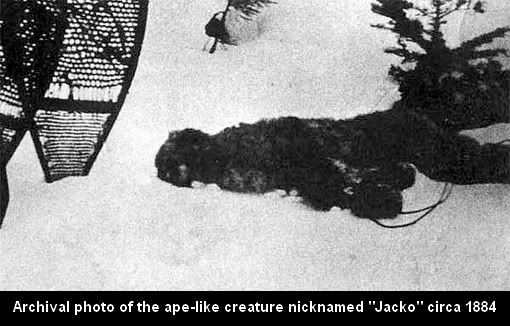
George Tilbury was a real person, born in England in 1853.  He really did live in Yale, BC.  Just a few years after this below article appeared, he was living in Vancouver.  He arrived in Quebec City in 1879, having come from England via Liverpool.  Just 5 years later, he would be in BC, acting as caregiver to Jacko, the BC gorilla.


Daily Colonist ran the story of a small hominid captured by a crew of railway workers in British Columbia during the summer of 1884.  It was described as “Something of the gorilla type standing four feet seven inches in height and weighing 127.”  Jacko had long hair, black and about an inch long, and looked human except for this hair which covered everything except hands and feet.  His forearm was reportedly much longer than a human one, and that is probably what gave him a gorilla image.  The beast was captured while lying hurt next to the railroad tracks and taken to the local jail, where Mr. Tilbury was to care for it.

The Mainland Guardian of July 9, 1884 (New Westminster, BC), mentioned the story and noted: “The ‘What Is It’ is the subject of conversation in town. How the story originated, and by whom, is hard for one to conjecture. Absurdity is written on the face of it. The fact of the matter is, that no such animal was caught, and how the Colonist was duped in such a manner, and by such a story, is strange.”

On July 11, 1884, the British Columbian (also a New Westminster newspaper) reported that some 200 people had gone to the jail to view Jacko, but that the “only wild man visible” was a man, presumably Tilsbury, who they laughingly called the “governor of the goal [jail], who completely exhausted his patience” answering questions from the crowd.  He is said to have told them the injured Jacko escaped just prior to the arrival of the townsfolk.

During the 1950s, a BC news reporter named Brian McKelvie became interested in Sasquatch reports of his current day that were being carried by his local papers. McKelvie searched for reports from the beginnings of the locality and found the Colonist article. McKelvie then told researchers John Green and RenĂ© Dahinden.   At that time it was believed that this was the only record of the event due to a fire that had destroyed other area newspapers in archive.

John Green continued digging, however, and discovered microfilm of British Columbia newspapers from the 1880s in the University of British Columbia, as listed above.  He then spent several years interviewing old-timers in Western Canada about their earlier Sasquatch encounters.  One of the interviewees was August Castle, who confirmed the story had been popular in his youth.

Later, Dr. Myra Shackley conducted research on hominoids and it has been widely reported that Dr. Shackley “did perhaps the most exhaustive effort in the search for Jacko.”   Her work, however, is simply an overview of the work of John Green. The claim that it is hers shows a failure to do actual research. The Castle interview was conducted in 1958, by Green, when Castle was 80 years old.  At that time, Dr. Shackley was 13 years old and living in England.  While her research on Neanderthal populations in Mongolia might warrant the title “exhaustive”, those who attribute the Jacko findings to her are mistaken.
Some enthusiasts continue to retell the story of Jacko as if it was a real report, but most serious researchers have labeled it “news fiction”, not unlike our modern day tabloid stories.


Tuesday, 14 May 2013

Newbies in the Midst


Paranormal Conference season has begun for 2013 and I’m pleased that people are taking a real interest in Cryptozoology.  In the past, these conferences have leaned toward psychic readings and ghost gadgets.  In the past few years, though, serious researcher in all facets of the field are making a difference;  in spite of the demoralizing representation on television.

A couple of weeks ago I spoke at a conference in Lynchburg, VA.  The topic of crypto was new to them.  Certainly they had heard of Bigfoot et al, but they had never heard of the very real, very serious study of such phenomenon.  It was a bit like seeing a baby take its first step.  Grown adults soaked in the wonder that is Fortean zoology with almost desperate thirst.  I felt honored to be the water-bearer.

The questions at these events continue to be more thoughtful.  Gone are the “Do you think bigfoot attacks people” questions.  Now, they ask about how to recover evidence and what sort of testing to do.  We talked about potential diet of lake and sea creatures.  We talked about the aerodynamics of a creature who, like Mothman, could fly without flapping its wings.  We talked about bone structure, and of course DNA.  It was a joy to behold.

Several years ago when I first started lecturing on the topic, a self-proclaimed skeptic challenged my opinion.  The crowd waited expectantly for me to get angry and rebut.  Instead, I asked him what his opinion was and we talked openly about it.  Both of us learned from that, but more importantly the onlookers learned that professionals can have different—even conflicting—opinions and that the research is far from standard.  That is something that is glaringly missing in most paranormal specialties.

Cryptozoology grows, and the researchers grow.  The findings become more important, more tangible.  Then the onlookers start getting intrigued.  Could funding for real research be far behind?